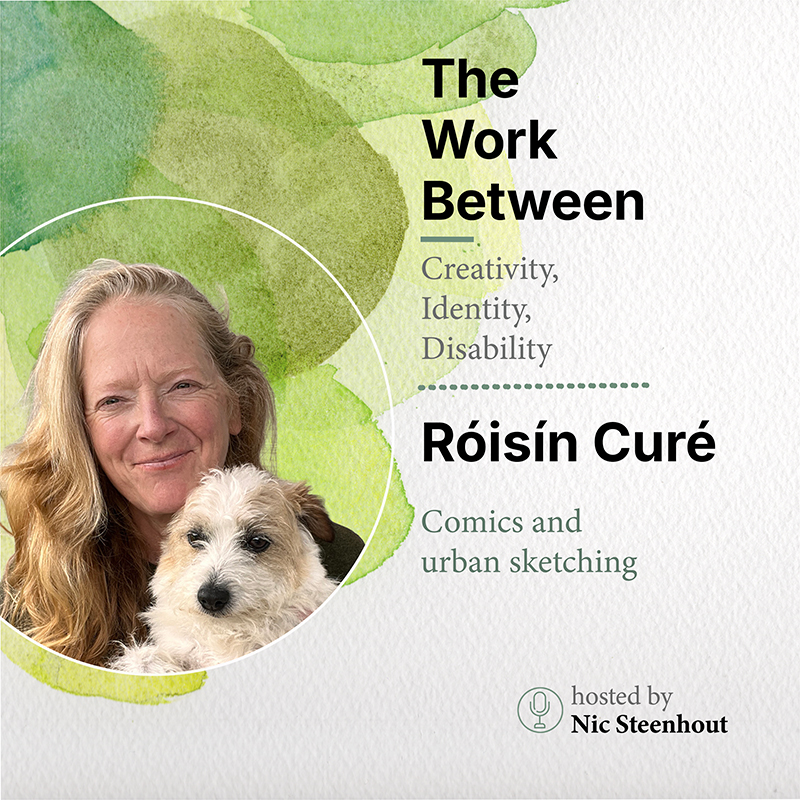
Róisín Curé on comics and urban sketching
Published on June 24, 2026
Summary
Róisín Curé talks about finally calling herself a comics creator after years of resisting labels, and about her new monthly comic Wild Atlantic Ink. The conversation moves through drawing from life versus photos, what years of sketching built in her hands, and the calm that sketching brings to a mind that has long carried melancholy. It ends up somewhere unexpected, with foraged food and homemade bread.
Listen to the episode
Timed Transcript
Static Transcript
Nic
Hi, I'm Nic Steenhout, and this is The Work Between.
Nic
In case you didn't know, I provide transcripts reviewed for accuracy by a human for every episode at the time of publishing. There's a text-only transcript that you could read if audio isn't the best media for you. There's also a timed transcript you can follow along while listening if that works better for you. You can access those directly on the podcast's website if they aren't displayed by your podcast aggregator. That's theworkbetween.show.
Nic
Before I get into what the show is, I want to say whose land it's made on. This podcast is recorded on the traditional, ancestral, and unceded territory of the Stó:lō Coast Salish people. The people of the river, whose presence in the Fraser Valley stretches back thousands of years. I name this territory because it belongs with what this show is about. The ways we decide whose lives are valued, whose work is taken seriously, and whose experiences are treated as problems to be managed. Those decisions shape everything. This show sits inside that. This is, was, and always will be First Nations land. That's not a formality. It's consistent with everything I, and this show, stand for.
Nic
Róisín Curé is an urban sketcher, author, and teacher based in Galway, on the west coast of Ireland. She came to urban sketching in 2012 and built a practice around capturing everyday and natural scences in ink and watercolor. She teaches sketching worldwide through online classes, a sketch club, and in-person workshops across Europe. She has published illustrated books including An Urban Sketcher's Galway. She has recently launched Wild Atlantic Ink, a monthly hand-drawn comic rooted in the wildlife landscape and stories of her corner of Ireland. We spoke about identity and how she identifies as a comic artist, about the relationship between sketching and mental health, about the pros and cons of sketching from life rather than from photos, and we even spoke briefly about foraging and cooking.
Nic
Hello, Róisín. Thank you for joining me on my show. I was really excited that you accepted the invitation because I'm a little bit starstruck, I have to say. So thank you for joining.
Róisín
Delighted. Delighted to be here, Nic. Thanks for inviting me.
Nic
For those of us who don't know you, can you tell me in a few words, what is it you do? What's your creative practice?
Róisín
My creative practice has suddenly taken a new turn, and I am now officially identifying as a comics creator. So I've struggled. You mentioned earlier that the podcast will discuss themes of identity as an artist and creative identity, and it's always been baffling to me how I couldn't identify, I couldn't put a label on what I do. And I would try out lots of labels in my head and none of them seem to fit. But I'm a comic, I'm a comics creator, and that fits just fine.
Nic
Comics creator.
Róisín
I'm a comics creator.
Nic
What kind of comics? I grew up with Tintin and Spirou and all the classic Franco-Belgian ones.
Róisín
My comics are like, I've only done one episode, and I'm just getting issue two to print. And it is like as if Hergé met David Attenborough, and we're driving in a clown car together. That's a good description.
Nic
Okay.
Róisín
I've got the Ligne Claire of Hergé, and I have the Passion for Nature of David Attenborough, and the clown car is because I cannot be serious.
Nic
I want to read that.
Róisín
You're going to love it.
Nic
Yeah, I'm sure I will. I have a bit of a passion for nature. I have several creative practices. I sketch, I quilt, and I do bird photography.
Róisín
Oh, wow.
Nic
And I'm privileged enough to live five minutes from where the bald eagle migration comes through every year. So between November and early January, I drive five minutes, and I can see hundreds of bald eagles in one spot.
Róisín
Amazing.
Nic
So this is just like, yeah, it is amazing. It's like mind-blowing. You know, how are we so lucky to have this? And at the same time...
Róisín
I live on an estuary, and my land backs onto an estuary. I am also privileged to have just discovered the Merlin app, and I'm extremely privileged to have a lovely son who likes to walk with me early in the morning. He does not like me listening to the birds all the time, but I am just enchanted by the combination of Merlin app and the bird life. I was just saying to my husband earlier today, this summer I am enjoying the birds more than I ever have in all my years, because I'm suddenly very, very conscious of them due to just listening out for them, really.
Róisín
And on our estuary, we just have everything. They all love our estuary, and it's a very out-of-the-way, undisturbed, unspoiled natural paradise. So it's just perfect.
Nic
That's wonderful. I assume you sketch those birds once in a while.
Róisín
Well, this will make you laugh, Nic. First of all, I've only just discovered the Merlin app, so I haven't really been conscious of birds. We've been walking parallel to each other without being aware of each other's presence for, you know, 50 something years, I suppose. But I was putting them into my first issue of my comic. So I used the Merlin app to draw them. There's photographs of the birds and I copied them. I mean, how how bad is that? I did not sit there with my binoculars and my sketchbook. I looked at my phone, screenshotted the ones I'd heard. I drew them from the photos that the app supplied.
Nic
Right.
Róisín
But I'm hoping that I used to be very much a purist. If it if it wasn't in front of me, it didn't get drawn. But I've changed. Now I feel I don't care what source it is, if it's my mind, if it's a photo. Obviously, I work from life all the time as well. But now it's about the art for the first time, not about the source.
Nic
This this is fascinating because I am not directly involved with the urban sketching movement. But I have attended a few events and obviously I've read the books and all that. And of course, it's it's always we draw on location. Yeah. And for me, who's come to art later, I've only been drawing for about five years. Doing it on location is extremely difficult because I don't have muscle memory on how do I draw a face? How do I get the perspective right? And... I've tried and tried and tried, and I beat myself up because I hate the results. I feel I'm not progressing. I'm feeling like backwards. So I've I've done a lot of thinking around, well, maybe using photos isn't so bad because.
Róisín
No, it's it's it's I'm sorry to interrupt you, Nic. No, it's not. I know it seems challenging to draw on location, but actually you've got much more information on location than you do from photo. You can see more clearly what's challenging is the fact that they move, the fact that they leave, the fact that the light changes. But those things counterintuitively actually become benefits because they force you to just draw whatever you can. And you're no longer obsessed about getting it right or wrong because there is no time to obsess about getting it right or wrong. And like that, there's no such thing as drawing a face, drawing a tree. There's only seing there's only seing and drawing what you see.
Róisín
And when I when I teach people to draw, I say. It makes no difference whether you're drawing a heap of rocks or a human face in terms of the actual technique you use. Drawing is drawing, looking is looking. It really does not matter what the subject matter is, except that some don't move and some do. And other than that, it's all the same thing.
Nic
So you giving yourself permission to draw from photos, how does that tie in then? Because you've done all the hard work.
Róisín
Yeah, yeah, yeah. You could say that you could say that I've done all the work I've been outside and, you know, inside. But drawing, drawing what I see in front of me, I'm not going to say daily, but not that far off daily for the last 12 or 14 years. And before that, I wasn't an urban sketcher, but I've been drawing regularly since I was about, I don't know, four or five, the usual young kid age. And I didn't stop. I drew all the way through my always. So I'm not I mean, I'm not going to go to the urban sketching, you know, I'm not going to go to an urban sketching meet up and start drawing from my head or from photos. But yeah, I've I've put in the groundwork and my comic is, for example, it's got a story about a seal who lives on the coast. And every time I draw his little rock pool that he lives in, I'm remembering the way the reflections go when I draw the sky darkening at night and the sunset. I'm remembering how I've drawn that. So many, many times I've drawn wet sand when he meets, he meets another seal on the wet sand at dawn. Well, I know how that looks because I've drawn it so many times, not a seal on the wet sand, you know, so my drawings are very much informed.
Róisín
And you say muscle memory, I've got bags of muscle memory now and I'm so glad. It's like it's like you've been driving all your life and somebody asks you to go and drive in a racetrack. And it's a really tricky racetrack. But you're like, yeah, I can do that. I've done it a million times. I'm comfortable with my car. I'm comfortable with the way the road bends, comfortable with any surprises that might come up along the way. I'm used to it. I've done it. So that's that's where I'm coming from in that way.
Nic
How did you find the racetrack? How did you get from what you were doing to doing cartoons and identifying yourself as a comic artist?
Róisín
I've been a comic artist since I was I mean, I was I was a Tintin obsessive. So, I mean, I've read I don't know, I've read three biographies on Hergé. I was looking for the secret to his beautiful line and his incredible mastery. And I really wanted to find out the secret. Now we're going back. We're going back twenty five years plus now, and eventually I worked out by myself what the secret was, which was that... He wasn't that great when he started, but he was always a great storyteller, but he wasn't that accomplished as an artist. He was OK, but he wasn't what he became. And then he worked on Le Petit Vingtième every had to had to produce a comic every single Friday without excuse, without fail. And he did that for ten years. And I began to and then I also discovered that he had a team and I thought, oh, oh, he had a team.
Nic
Oh, OK.
Róisín
So it's not just Hergé, it's Hergé and his team. But I realized that just by sheer volume of output, he became a master. And as I say, he had to bring it every single Friday. He had to produce the goods and he had a team. So I was comforted by that. And I thought, OK, it's it's possible through sheer dedication and practice because I was always very technically able, but nothing like that, nothing like that. And then. And then.
Róisín
So I was a comic artist all my life. I've always been the one to to make people around me laugh through my drawings. I've always done that. I've done comic strip series of my friends who never had any boyfriends. And then it was me who never had any boyfriends. And then it was there was always something for me to draw a comic strip about and on social media. And so when I joined social media in 2013, I quickly realized that the public had no interest whatsoever in any of my funny stuff. So I just didn't bother putting it there. And it was something I just did for my family to make to make my family laugh. And, you know, we share a sense of humor. So it was always great fun. And then I've been doing this nonstop ever since. It was just a little private pleasure I had. And then it was something that was always an ambition of mine. But life goes on. The years go by and you think, you know, I'm very happy with what I'm doing. I'm very lucky the way things have worked out. I've done very well. I've had lots of these creative platforms that people could only could never even have dreamt of in time gone by. And I've had them all. And I live in the middle of nowhere.And I'm a mom who stayed at home to raise the children. And yet I got the breaks because of social media. So I felt very grateful. But then about three months ago, I came across a woman who had started doing a comic and it's been very successful for her. She's had viral success she's bringing in a very decent wage every month because of the success of the comic and I thought oh my god that's what I want to do that's that's what I can do. I can I can do this I can make a comic because I've been making little booklets of all sorts for years self-publishing. I've got some traditional traditionally published books out but didn't really want to do that anymore. And then I couldn't remember who she was you know the way in social media if you don't make a record of it it's gone. There's no way you're going to find it.
Nic
Yep.
Róisín
And then my younger daughter introduced me to um you know Gemini. So I said to Gemini so I'm looking for this cartoonist, this this comics creator and I don't know her name but she's bringing in $14,000 a month because I was trying to give facts and figures she is she was interviewed by a newspaper but I don't know which one and little lady. And I was able to find her and I thought oh my goodness I've got a medium-sized audience small to medium-sized audience I'm going to give this a try. And with that I started drawing. I started planning and then it was like the floodgates opened the idea started coming through and at the same time as this happened this is the really strange thing how things come together. When the time is right... um I follow a guru from San Diego, a fantastic man called Pat Flynn really fantastic guy and he sometime in November December he said right on January the 12th we're all going to do one reel and a short a YouTube short every single day one minute long from one month. So I was like I wouldn't mind doing that, yeah that's a good idea I think I can do that and it was going to start on January the 12th. And on January the 12th in the morning I said to my husband... I said this is the day I'm supposed to start but I don't know what I'm going to do. I have no idea. I haven't planned it so I thought well nothing to lose nobody's paying me. Nobody cares whether I do it or not so do whatever you want. Which is always a great way to start any creative endeavor and I had been drawing the little um animals from my area my beautiful part of Galway where I live. And make believe animal well they're real animals but they're... They all walk on two feet and they've got like 18th century clothes and you know they're they it's centered around the ruins of a manor house a few years ago.
Róisín
And I thought well I'm going to do this I'm going to do this I'm going to do this. And I thought well I'd like to do that so I started drawing them and one thing led to another and I started being able... I... A story began to form which had never happened for me never been able to write fiction. um And suddenly here was a world that had just opened up in front of me. This this this this personality who began to take on a life of his own and I suddenly found I had plenty in the tank. um Yeah and that was great and I was like oh my god I've discovered my illustration stroke storytelling mojo. And then when I saw the comics lady about a month and a half ago I was like oh my god I can put them all in a comic I can put them in the comic. I can have a story in the comic. I can do something on the flora and fauna I can do the birds. I can do a recipe I can go and gather wood. I can do a lot of things. I can do a lot of things I can do a lot of weeds and make food out of it because I've always done that and I was like oh my god and I haven't left my studio since. I'm here you know six in the morning so I don't know how long it'll last before I fall over with exhaustion but so far so good.
Nic
And you're about to release the first one.
Róisín
I've done the first one the first one I printed 400 copies I have about um let me see I have about 80%, 70% of them left but I fully expected that um and I'm perfectly happy I'm going to lose so much money on this venture but I don't care because this is my artistic expression. um and you know... You you put you you paint in your studio and you you you put your work up in a gallery and you don't second guess the audience. If you do well that's a mistake in my opinion. So this is the same thing I'm just making it. I am certainly not second guessing the audience but I'm going to... I'm just pleasing myself and that's always a good start.
Nic
So one of the questions I often ask is do you do art for yourself or do you do art for others? And this sounds like almost like you're doing it for yourself without really caring for the audience.
Róisín
I'm not I don't I I tell you what my father my father, he left us in November, and my father and I were very close. And he used to always say to me he had a horror of being bored. This was his terrible fear and he, whenever I said to him dad I'm working on a new book, he'd say is it boring? I say well uh I I I hope not. He said just don't let it be boring. Don't be boring okay right I'll do my best. So that in that sense I try to please the audience I really don't want the audience to be bored. They're giving me their time, they're giving me their money so it's my responsibility to make sure they're not bored. um So I want to give them value and also I canvassed my wonderful students. And I asked them... I told them about my comic I was planning and one of my students is a real straight talker. And she said okay Róisín what is the value for me when I buy your comic and I was like um... Oh gosh well so I said there'll be maps. She's like okay I like maps. Maps are good. And I said they're... There'll be recipes. She said uh-huh okay that's good. But it she really helped me to keep that front and center in my mind. Give them value and above all make sure they're not bored. So but within that you can really please yourself. You can you can draw the recipes just how you want to. You can you can present them exactly how you think they should be presented and every... Every page I approach is is a playground. It's a 100% playground how am I going to present this, what would this creature say, what would what would, be how do these colors look together, do the colors... Do they harmonize?
Róisín
And I have on occasion thrown whole pages away because I didn't I didn't do myself justice you know. So I'm I'm trying to really do my best. This is my this is my exhibition this is my art gallery because I don't ever put any work up on a wall.
Nic
Someone asked me recently if I could do a portrait of themselves and I said sure I can give it a go. I don't promise anything but I can give it a go. And then they said well you know if I don't like it you can always do revisions. And I had to say well you know I am using actual ink and actual watercolor on actual paper it's not like Procreate. I can't do an undo. And you saying you're throwing out whole pages is a little bit like that right? For those who listen in that don't understand we're we're talking about actual physical art not digital art.
Róisín
Nope. Now mine is a hybrid a little bit because I draw everything by hand. Every time I draw a speech bubble, I draw a speech bubble and I draw little track lines with a pencil to make sure that the lines are nice and neat. And if I change my mind about what they've what they're going to say I draw a new speech bubble with new track lines. If my hand if I'm too eager and my hand smudges the ink before it's dry, I have to draw a new speech bubble. Sometimes the shape isn't quite right but the writing is perfect and I've said exactly what I want to say so I go ahead and scan it and then I clean it up and then I remove the background. I might adjust the scale. I drop it in. I layer my work. I use graphics program to layer to flatten images, to erase things. But everything everything is created by hand and then it's manipulated on the screen.
Nic
That's an interesting process. Tell me more it works.
Róisín
It's fantastic I I'm thinking I'm giving a course next May in Greece May 27 and it's going to be um illustrated vacationing journaling. And I'm going to teach them how to use the graphics program because it's free. It's GIMP, it's open source. It's GIMP and I did not... For the first time I did not ask my son and my husband. Well my husband would just say he's busy but my son, I did not ask my son to install it for me. I did it all on my own, which is amazing for me. So if I can do it anyone can do it. And it's very powerful. I've only used a hundredth of what's available on it. And if I can't do something I google how to do it, and if I still can't do it I go and ask my son and he's he's brilliant at it. He showed me... So um for example I... In the coming issue I have um one of my owls is getting used to his new quarters his new aviary and I wanted to show the grill um you know the bars in front of the aviary because at one point he, the little owl I mean... It was so adorable he flew over to me and he hung on to the the the wires with his two little talons and his two... He let his two wings dangle down like he looked like a giant white feathery fly. It was so sweet and he's only a baby. He's only he's only a couple of months old and uh he stood there with his two little feet and his wings hanging down and I, of course, I had to do the grill because otherwise what's he hanging on to.
Róisín
So I did the grill. I it worked really well and uh it looked it looked just right but it was much too dark. It was black. I used black ink for it I should have used gray and uh when I put it in front of the the drawing of the owl it just it was really... um It was really uh interfering with the drawings of the owls. So I was trying to... I was trying to adjust the opacity of the grill but I didn't really know what what what it was called. I mean that's how bad I am. I thought is it the gradient? Is the transparency? What do you call this? So I tottered over to my son and he said it's the opacity and suddenly he showed me how to adjust the opacity so I was able to drop the grill on the owls but this time they were nice and pale gray. And I could test different opacities to see what was a good balance between you know not being too dark and being too light. So I love the fact that I can manipulate very key elements of design like that. um Now my... The only problem is my eyes get very tired. I'm on a MacBook Air. It's very small screen and I probably should get a bigger a bigger a bigger laptop but... um So the result is my eyes are extremely tired at night time but that's okay. I mean you just have to take lots of breaks you know. I have a dog and the dog loves to chase a ball so.
Nic
Yes uh my dog is hard to sleep on my feet right now and...
Róisín
Oh lovely
Róisín
Yeah. You mentioned Hergé and uh I'm gonna share a an anecdote from my life when I was very young. I think I was 10, 11. uh There was in Montreal an exhibit for Hergé, a retrospective of his work and um my cousin and I we were talking and we were saying oh wouldn't it be great if Tintin had an adventure in Quebec. And um there and then we sat down and we wrote a letter to Hergé saying "hey why don't you have an adventure of Tintin au Québec"? And uh somehow the people the journalists that were there um filmed us writing this letter uh to to Hergé. We were sitting in a corner of the museum and the letter made it to him somehow. And we got a response. So uh somewhere in my mother's archives there is a letter from Hergé saying "hey this is a wonderful idea and maybe Tintin will come to Quebec right now but I'm busy working on a new project", which was his last one that was never published because he died. And then you know I think it's the Alph-Art. So so yeah that's that's my connection to to Hergé.
Róisín
That's amazing yeah that's amazing. Well I have an anecdote about Hergé as well. Indirect and this is a very sad story. I lived in Paris in the early 1990s and um I was living a very miserable lonely life. I had a really bad boyfriend who I really should not have been hanging around with at all. It was a real problem and I was trying to get away but I didn't have a job and I was at the mercy of his largesse. So it was not a good situation I was trying to get jobs and I was being taken care of. And I was turned down here, there, and everywhere and then I saw a job drawing Tintin cartoons with a studio in Paris. I thought oh well I can do that and I went for my little trial and I drew some Tintin cartoons and I drew better than I'd ever drawn before. But in retrospect I don't think they were that good to be honest but they were but they were better than I'd drawn normally so I really was sure that I had a chance. Anyway I didn't get the job and um a very nice manager told me that... It wasn't a manager, he was a sub manager or something... He told me he'd been trying to get a woman on his team for 10 years and he had yet to succeed. He said they just aren't going to hire women. So that kind of made it better because it felt like it wasn't really my fault. I couldn't do anything about it but... um that's my sad Hergé story. And I cried and cried and cried and then I went to see um Green Card with the Gérard Depardieu and it was really funny and it cheered me up so it wasn't too bad.
Nic
Yeah. Part of my show is is talking about disability and art and before we started recording I I pointed out I know you don't identify as disabled. You're not disabled but in reading your blogs, listening to some other interviews you've done, there's there's been a a running thread I think where you speak a lot about melancholy and uh you've used word like taming the demons and brain worms and all that so I think that those themes fit in within the context of of disability in at a stretch. But um one thing that I was really interesting in hearing is how sketching for you is letting you quiet your mind. Can you tell me a little bit more about that?
Róisín
Yes I I'd be very happy to um I I was... I mean that that example of what I just told you in Paris, that was just very normal for me. I mean that was just my my lot in life. That I would you know frequently be absolutely miserable, you know, and it didn't have to be because I was alone in another city. It could be anywhere. It could be in company. It could be alone. I come from a very big family but it was no guarantee at all that I wouldn't be you know in trouble that way. And it was just a part of my persona that I was very disappointed in because I it's nobody likes to have that kind of horrible little, you know, creature yapping at your feet waiting to pounce at any moment. Because melancholy is horrible and and dwelling on the worst that can happen and being a catastrophist and, you know... But also just just general depression um and in fact um so I'm and and... I did have um I did I have a... I was the subject of a of an attack in Paris and in fact it was the same the same man I just referred to. And unfortunately that led to... um It it really opened the door... The things that had been sort of kept at bay suddenly the gates, the locks broke, and the gates were open and I went through. I went into what what I came to realize was just PTSD, regular old PTSD, post-traumatic stress disorder.
Róisín
Which I didn't know what it was. I just thought I was going mad and a few years later um when I heard a psychiatrist on the radio, I remember I was hoovering my bedroom, and I I heard a psychiatrist on the radio talk about this feeling of thinking you're going mad and thinking that you're jumping off a cliff into an abyss and there's nobody can save you. And that is I I just stopped hoovering. I thought oh my god he's talking about me. There's I'm going into madness and there's nobody gonna stop me and I realized then that... um That it was it was an actual thing it was an actual thing. And then I a little while later I discovered that people who survive near-death experiences often have that when you're faced with your own mortality. It happens to people who've survived plane crash, who have um been you know had a heart attack, they can get this PTSD survivor thing you know. It's just too much for your brain to handle that you were this close to being killed but you're not you know. And I had tasted death at that time when I was attacked and I was very close to being to being killed but I wasn't. And um I began to get used to this creature that was big. It took it took a permanent residence in my mind and uh it was unpleasant but it was something I couldn't get rid of. It just lived there and it manifested in a kind of... um It manifested in a kind of a knot in my in my chest. Time went by, went to university, got married, had kids that was very again it kept rearing its head when you're bringing up children on your own, it's not a good place for people who have this this this this weakness.
Róisín
And then in 2012 I discovered sketching and needless to say um it occupied my brain because when you're struggling to try and draw something properly it's flipping hard. You know it looks wrong all the time and it's hard.
Nic
That's where I'm at.
Róisín
It's very hard. It's very hard and uh all kinds of things happen but it's very exciting. And I fell in love with sketching. So I I and I got addicted so I started sketching a lot. And um I came back to Ireland, that was when I was living in Mauritius, and I came I came back to Ireland and I kept on sketching. And then after about maybe a year or two I began to notice something very curious. Once I had been sketching for about an hour I would get this sense of calm that would descend on me. Because I used to spend hours sketching at the time. Now I don't know maybe but at that time I'd just fallen in love with sketching, and just like falling in love with anybody it's all you want to do. So I was sometimes four or five hours more just sketching and I began to notice this really strange thing after about an hour I would get this feeling of calm and like a flow... Of course I know now I was entering the flow state and I realized that once the flow state began I I no longer made a mistake. My drawing would just happen automatically and it was very enticing. This was like "what is this magical feeling?" and then the more I sketched the faster this state would descend until about four or five years in after a lot of sketching it would happen automatically as soon as I started. My brain obviously developed some kind of a muscle memory and the second I would start sketching I would feel the calm. And then it began to affect the rest of my life when I wasn't sketching and the melancholy went away.
Nic
That's wonderful
Róisín
And I don't get it anymore I'm 100% cured.
Nic
That's wonderful
Róisín
I know it's a miracle to me. It's... I had until I was 44 when I started sketching it was something that was there to a lot lesser or a greater extent. And I was able to... And now it's gone so I'm very grateful. And I I have had many students say to me they they're... There are people who were a bit like me. Intense people people who were struggling mentally in some way or another and they've come to me and said "I can't stop sketching it's midnight I can't stop and I'm just on a high". I had one woman not too long ago who said she said "I've been on antidepressants for 30 years and I've stopped taking them and why did nobody ever tell me that I I can I can sketch
instead why did no one tell me?" So I do get I do get people who've got a similar experience it happens quite a bit.
Nic
Yeah well I'm I'm in a similar boat not quite cured by any stretch of the imagination but um... I was um labeled with treatment resistant depression so for the last... Since I've been 15-16 I've had ongoing low-grade depression and then sometimes really acute and these days the only times where my brain really quiets is when I quilt, when I go bird photographing, and when I sketch
so. um Yeah I I think there's something to this whether it's sketching or or exercising creativity which is ...
Róisín
I think it is I think it's I think that's the common thread it's using your
hands physically. It doesn't work if you're just thinking about it. You have to use your hands and it has to be something that you have it has to be a problem solving thing whether that's you know... I don't know rearing rare insects or whether it's you know it has to be something to do with your
hands that you really have to focus.
Nic
Yeah
Róisín
And you really have to think. You have to solve you have to solve problems. We're humans. We're built to we're built to solve problems.
Nic
Yeah and then I think part of it too is you have to get to that point where you get to the flow state.
Róisín
You do you definitely do I I think you're right on that. You do and and and as I explained for me it came slowly. It came slowly and um um and and and and the prowess as sketching and the improved ability it came hand in hand with that and that was its own rewards. And obviously it helped my career in many ways but that's completely separate. The big gift I had was being fixed and um I mean I I you know I've always been a very uh how would I say ill... It's an uncivic minded person I I you know I'm I'm ungenerous in my mind. Ungenerous towards others and and and and sketching has definitely made me a much more relaxed and chill and nicer person. I'm not sure my husband would tell you the same thing but I know for a fact that I've been a very uncivic minded person for a long time. And I've been... He's definitely got a nicer wife than he did before.
Nic
You say you're ungenerous and yet you you give up of your time, you share about sketching and urban sketching, and drawing, and you have YouTube and Instagram and and you're giving of yourself. How is that ungenerous?
Róisín
Well yes maybe I'm very generous in physical terms. But what I mean is is if I'm if I've always thought the worst of people. Like if you know it'd be mean-minded mean-minded you know I wouldn't be kind in my mind, you know. I'd be mean in my mind. um But now I'm not so mean right. I'm becoming a little bit nicer, I think but that's definitely... You know that phrase they say that um "damaged people aren't very pleasant because they're so
busy trying to look after themselves they don't have time for others"? I think that would describe me quite well.
Nic
Still now?
Róisín
No no no no I'm loving it. I'm loving it. I'm lovely now.
Nic
Well you are lovely but I... I can't see into your brains. I can't see into your mind. I don't know if you're thinking "oh this Nic really should shut up"!
Róisín
No no no that's in the past it's in the past.
Nic
What other creative things do you do? Cartoons, drawing, sketching... Do you do anything else?
Róisín
um I'm a sewer. Yeah and I designed my sketch pocket. My little bag for artists. Oh yeah um so I I don't know maybe 10, maybe 9 versions. And then when it was taken away for, you know, mass manufacture if you like, then there was more iterations but they weren't me. They were done by the factory. um So I sew... um Do I have any other? uh What else do I do? I guess I paint and acrylics and oils but only very occasionally. um Give me an example. I mean I do lots of things I'm just trying to think about it. I'm just trying to think about it. I'm just trying to think about it. I'm... What do I do? I make models. No used to anything to do with using your hands I would say. I don't I don't knit. I don't crochet. um I like sticking things. I like I like cutting things out. I like glue. Oh I love glue and scissors. You can't go wrong with glue scissors and some nice colorful paper.
Nic
So collage
Róisín
Collage I like. I like I like baking. I like cooking. I like arranging a house to look nice. um Yeah lots of things.
Nic
Cooking and baking. um I'm starting to make connections. You said in your comics there's recipes. Are they actually recipes for humans to try or are they recipes for the characters in your comics to...
Róisín
Nope they're genuine actual recipes and they're foraged food so...
Nic
Oh nice
Róisín
Food you find in the world and I've done that since I was a teenager. um I used to pick rose hips and try and make rose hip syrup. um None of my brothers and sisters did. And I've got lots of them I do not know what they were doing if they weren't gathering food from the countryside but I was. um I was always trying to make my bread rise and... um My father was a wonderful bread maker and somehow I don't know... I do not know how his bread worked really well and mine didn't I'm sure he told me how to do it but it didn't work so... um You know fruit jams next week. I'm this week actually this week I'm going to pick elder flowers to make some cordial. um And in next month's recipe is um I make nettle soup and some really gorgeous Irish brown bread and also some nettle pesto and um so lots of things with nettles. And then in the first issue it was sea beet. The vegetable that grows on the seashore and it's like chard. If you have chard and it's delicious. It's delicious. Can you imagine coming across miles and miles of free perfect fresh chard that's just there to be taken and that's what I did. In... It's only there for about a month. um But I I took lots and I even put some in the freezer so I'm very pleased. And then in the in the autumn I'll make sloe gin and I'll do something with mushrooms probably. When somebody shows me because I have no clue. I only... I've... There's only a couple of mushrooms I'm
familiar with but there's lots of mushrooms I'd like to I'd like to learn about so...
Nic
You don't want to mess around with mushrooms unless you you actually know what you're doing.
Róisín
No I don't want to mess around mushrooms. I like being alive.
Nic
Bread. Do you do yeasted bread or sourdough?
Róisín
Yeah I do... I don't do sourdough. I um I did during the pandemic and um I I made a disaster with sourdough. I somehow allowed it to get contaminated with bacteria but I didn't know. So I gave myself a gut infection from... And nobody tells you that you know yeah... um They... Everybody was talking about how wonderful it was, how healthy, but every time I took a bite I would get a terrible pain and I thought what's going on? Something's going on here. But I've been making yeast bread um for 30, 40 years and I also make soda bread. So I love I love making bread. I love making unusual bread and I love playing with the timing so that it changes the fermentation. You know I really like making fun bread and now my son makes makes bread as well.
Nic
Yeah I've I've been making sourdough since the start of the year
and I am very careful about my starter making sure it's it's healthy
Róisín
It's yeah yeah
Nic
The one thing I'm not mastering yet is the the baguette because I think...
Róisín
No I haven't mastered it. I haven't mastered it. I saw YouTube recently on making a baguette my son and I are watching it and... um I think I think I think it's it's well obviously it's possible but it's it's very complicated
Nic
Yeah I was told that because I have a gas oven and it's not a commercial oven it's too vented to hold the steam to have the right...
Róisín
See, that's what I mean. That's what I mean. I think we just have to go to the
baker to get our baguette.
Nic
Yeah well as I said I live in the back of beyond. The nearest baker is an hour and a half from me so...
Róisín
Same that's why I started making yeast bread because the bread you buy around here is awful, or it certainly was 30 years ago. um And you know there's nothing like the most beautiful smell of bread that's been rising overnight and this bubbles and oh it's just beautiful!
Nic
Let's get back to comics. You've got one published.
Róisín
I have.
Nic
You've got one coming out.
Róisín
Mm-hmm
Nic
Do you know what your third one's gonna be?
Róisín
I I have well the magazine the comic is called Wild Atlantic Ink and it comes out once a month.
Nic
Right.
Róisín
So you you can buy it locally in the local shop for a reduced price because I sort of feel it's nice for the locals to be able to buy it. And then you can buy it as a subscriber so it goes out all over the world to my subscribers. And they are all sent out on the same day. 14th of each month and that way no... There's no sneak peeks beforehand. And then I wait 10 days after the 14th to be sure that everybody has it and then I can show people what's in it. That's the theory anyway. This month I was so busy. I was teaching in different parts of Ireland so I haven't even showed anybody what's in the issue that's been out for three weeks. Three weeks ago I sent it so. um Like for example I went down to the shore last week because I wanted to include the beautiful wild flowers that are on the shore at the moment and I was looking at them, and they're so beautiful, and I was thinking "oh how can I present it in an interesting way?" And I'm again my father's words "don't be boring don't be boring" Dad thanks! So um so then I suddenly thought I was driving home I was there by myself and you know that's okay it's cool um and I was driving home and suddenly an idea popped into my head of how to present it with a character with a theme so that's the beauty of this this this this this project.
Róisín
And and then I asked um I asked I asked was it ChatGPT or Claude I can't remember. I think it was ChatGPT. I asked ChatGPT to suggest some creative uh ways to to to do ideas. um And I have no shame about that. I should have but I don't. And uh he, ChatGPT came up with a brilliant idea. I shouldn't be saying this because I should pretend it's my idea. But they mentioned something about um a ghost. And I realized that I it just it just sparked a cool idea like. I live right next to this big huge ruined house and it was built in 1789 and it has been empty when it was since it was burnt out in 1920. And the people who lived there... It has a very very colorful past and, it's not a nice past. It's it's not the good old days it's the bad old days, right? It's a tale of poverty and um and and exploitation of the locals. But that's... I'm not going to be miserable I mean... Again my father would say don't be so miserable.
Róisín
So I was thinking I could have a ghost who lives in that house because people talk about that house being haunted, and a few people have talked about they've seen ghosts there. I don't believe that, it's not... That's not the point. I'm going to have a character who lives there. He's a ghost and he's exploring the area. And I don't know yet what I'm going to do but how fun is it to have your own comic that you can make up any old crap you want and you can just allow these characters to take on a life of their own. They exist in your mind. I'm lucky enough to be able to draw exactly how I want something to look really really fast. I have all the tools I have a beautiful studio I have the time so I feel like all my Christmases and Easters have suddenly arrived.
Nic
That's wonderful
Róisín
I'm so happy
Nic
Before we wrap up is there anything you want to share that I didn't ask or you think we should talk about?
Róisín
Okay um well I think it's very interesting about um identifying as an artist and I... I look... I don't know is it a male versus female thing. A man's career is his identity. A woman's career, and don't shoot me, is as a mother. um That's our biological purpose and I have very strong feelings about that. um And I do believe that women have been sold a pop that, you know, a career is just obviously... You know a lot of people want kids and can't have them. A lot of people don't want kids. You know it's different for everybody but this idea of identifying as something with a name in it... I don't know if it well... I can only speak personally with authority. For me it just wasn't a thing it just wasn't a thing. I'm just me. I'm just me. I'm not a artist, I'm not a mom, I'm not a, you know, you don't have to put a label on yourself
Nic
Yeah
Róisín
um So so and yet people think they do. And for my husband that's very important. He... He was an oceanographer. He's no longer an oceanographer. This is what he says but it's a thing you know it's a thing. um So so from identity purposes yeah I do see... I do see people wanting to call themselves a thing. um I'm I I and it's like it's like in urban sketching they say drawn draw verbs not nouns. I would say I'm a I'm a verb I'm not a noun. I'm a doing. I'm not a being. I'm definitely a doing, not a being. So yeah I think you don't need labels you just have to you know do
Nic
You are what you do.
Róisín
You are what you do yeah well I'm a doing for sure. Yeah um and I suppose the last thing I would say is that uh it's it's a massive privilege to be healthy settled financially secure enough that I can take some risks. Creative risks and to have access to social media so that I can actually share the joy and the wonder and the the the the passion of creativity. um And to inspire other people and maybe get them out of the the the the holes sometimes life throws us at us. Yeah through creativity as people have done for me. As Danny Gregory did. As Hergé did. As all the incredible people that I follow online and listen to their podcasts and all those people who have shared so generously um and have changed my life. Guy Raz is another one I just adore Guy Raz and I just love him and his podcast. um So I'm just pass it on a little bit I suppose and uh and it's just it's an honor it's a it's an honor to be asked to talk about it and to share it and...
Nic
So social media. Where can people find you? Where can people find subscription info for getting your comics and and seeing all you do?
Róisín
Sure okay well my comic is on my website roisincure.com and you'll find it under I think under membership. My my webmaster has put it under membership so you know. I don't think it's on the home page. You might have to dig around a little to find it and it at the moment it costs 10 euros 99 delivered on your doormat every month. um And then you can get it for slightly cheaper if you buy the the year the year subscription. um I was putting up reels every single day since early January as I mentioned and it's not that I've run out of steam it's not that I've been burnt out but I can't even scroll anymore because I'm doing a comic all the time...
Nic
Yeah
Róisín
16 pages every single month that's one... It suddenly hit me that's that's a page per two days! Help but. um That's what I've chosen and you know I am a fast I'm a fast worker so I think it's going to be okay. So Instagram Róisín Curé. YouTube Róisín Curé. uh Where else am I? TikTok I've just started. I've stopped now but for a few weeks there I was wasting time on TikTok. Not going to do that anymore. And um so it's just my name on all all the platforms, you know. um I don't do Threads, I don't do BlueSky. What else do I not do? uh Anyway Instagram YouTube those are my principal ones and if you've got a lot of time on your hands then go to YouTube and you won't be looking up for a lot of time. So I think it's time same as Instagram there's a lot of stuff there.
Nic
It's all good stuff too.
Róisín
Thank you
Nic
Thank you so much for opening yourself and chatting with me and sharing all those insights I really enjoyed that.
Róisín
Oh, thank you, Nic, and likewise I really enjoyed talking to you and
you know don't be a stranger reach out anytime I always love to chat.
Nic
I will be sure to do that, thank you.
Róisín
Thank you so much.
Nic
If you enjoyed this episode if you were inspired in any way or if you learned something please leave a rating or review on Apple Podcasts on Spotify or whatever podcast aggregator you use. Ratings and reviews really do help. Thank you.
Nic
And that's it! I'm Nic Steenhout, this is The Work Between. If this sounds like the kind of conversation you enjoy, like, subscribe, and I'll see you in the next episode.
Key themes
Show notes
Róisín Curé is an urban sketcher, author, and teacher based in Galway, on the west coast of Ireland. After years of struggling to put a label on what she does, she has recently started identifying as a comics creator, and she has launched Wild Atlantic Ink, a monthly hand-drawn comic rooted in the wildlife, landscape, and stories of her corner of Ireland.
In this conversation, comics and sketching open the door to bigger questions about identity, mental health, and how a long creative practice actually gets built. Róisín describes her new comic as what you might get if Hergé met David Attenborough and the two of them drove off in a clown car together. She means it. The Ligne Claire of Tintin, a deep passion for nature, and a refusal to take herself too seriously all sit side by side on the page.
We talk about why she resisted creative labels for so long, and why “I’m a verb, not a noun” finally felt right. We get into drawing from life versus drawing from photos, and why she gave up being a purist once decades of sketching had built the muscle memory she relies on now. She walks through her hybrid process: everything is drawn by hand first, then scanned, layered, and adjusted in GIMP.
We also spend time on the relationship between sketching and her mental health. Róisín talks plainly about years of melancholy and the calm that arrives when she drops into a flow state, and about the students who have told her something similar. Along the way we wander into foraged food, the recipes she draws into the comic, and the bread she has been making for forty years.
It’s a conversation about comics. It’s also a conversation about what happens when you stop asking what to call yourself and just keep making the work.
In this episode
- Why she now identifies as a comics creator after years of resisting every label
- Wild Atlantic Ink, her monthly hand-drawn comic about the wildlife and stories of coastal Galway
- What she learned from Hergé about reaching mastery through sheer volume of output
- Drawing from life versus drawing from photos, and why she stopped being a purist
- Muscle memory and how years of daily sketching changed the way she works
- Sketching, flow, and the calm it brings to her mind
- The melancholy she lived with for years, and the role sketching has played in her mental health
- Her hybrid process: drawing everything by hand, then layering and editing in GIMP
- Foraged food, the recipes she draws into the comic, and decades of making her own bread
- Making work to please herself instead of second-guessing the audience
A quote that stayed with me
“I’m a verb, I’m not a noun. I’m a doing. I’m not a being.”
About Róisín
Róisín Curé is an urban sketcher, author, and teacher based in Galway, Ireland. She came to urban sketching in 2012 and built a practice around capturing everyday and natural scenes in ink and watercolour. She co-founded Urban Sketchers Galway, teaches sketching worldwide through online classes and in-person workshops, and has published illustrated books including An Urban Sketcher’s Galway and The Urban Sketching Handbook: Drawing Expressive People. Her current project is Wild Atlantic Ink, a monthly hand-drawn comic.