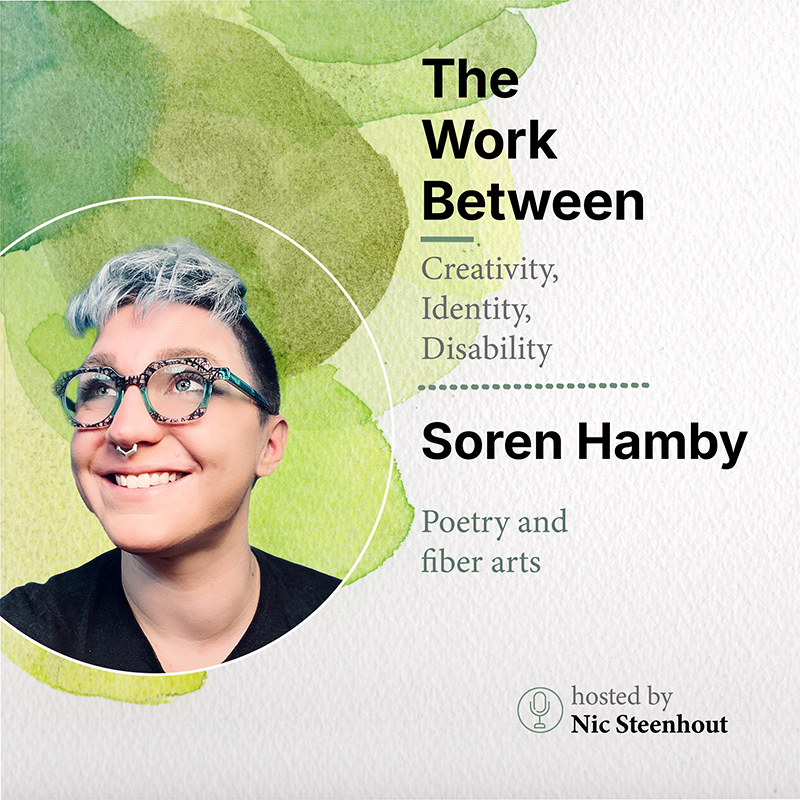
Soren Hamby on poetry and fiber arts
Published on July 22, 2026
Summary
Soren Hamby, poet and disability rights advocate, talks poetry as necessity and expression, the craft of specificity and editing, and living with vision loss and late-diagnosed neurodivergence. A candid look at writing as self-reflection, advocacy, and a way to make disability's realities understood.
Listen to the episode
Timed Transcript
Static Transcript
Nic
Hi, I'm Nic Steenhout, and this is The Work Between.
Nic
In case you didn't know, I provide transcript reviewed for accuracy by a human for every episode at the time of publishing. There's a text-only transcript that you could read if audio isn't the best media for you. There's also a time transcript you can follow along while listening if that works better for you. You can access those directly on the podcast's website if they aren't displayed by your podcast aggregator, that's the workbetween dot show.
Nic
Before I get into what the show is, I want to say whose land it's made on. This podcast is recorded on the traditional, ancestral, and unceded territory of the Stó:lō Coast Salish people, the people of the river, whose presence in the Fraser Valley stretches back 1000s of years. I name this territory because it belongs with what this show is about: the ways we decide whose lives are valued, whose work is taken seriously, and whose experiences are treated as problems to be managed. Those decisions shape everything. This show sits inside that. This is, was, and always will be First Nations land. That's not a formality. It's consistent with everything I, and this show stand for.
Nic
My guest today is Soren Hamby. Soren is an artist and advocate who survives under capitalism as an accessibility and product equity designer. Their natural state is to build systems, frameworks, and communities, and to challenge the hidden structures that determine inclusion. They live in New York's lower Hudson Valley on unceded Ramapo Lenape land, reshaping perceptions of living with multiple disabilities and intersecting identities. When they're not busy with small goals like changing the world, you'll find them painting, doing fiber arts, writing poetry, or collecting different ways of making and creating, which they see as essential human needs. Most of our conversation revolved around poetry. We also spoke about fiber arts and the line between necessity and expression, about vision loss and the pull between digital and physical media, and the impact of late neurodivergence diagnosis.
Nic
Soren, thank you for accepting to talk with me about creativity and identity and disability. Welcome to the show.
Soren
Thanks so much for having me. I'm really glad to be here, and this is such a great thing that you're doing.
Nic
I'm glad you enjoy that. Let's start with the first question, which perhaps is the most obvious one. But tell me about your art or creative practice. What is it that you do? And I think, I think you do a few things that are related to making and creating. So tell me a little bit about that.
Soren
Yeah. So there's a couple of things, and I I kind of divide them into more necessity or expression. So one one realm that I kind of get into is doing things that are I make things because I can't get them commercially or I can't get them easily. So it's like like knitting and crochet and sewing and things where I'm you know making things with my hands, and the the primary object is not to make something that's decorative or or narrative. And so I've been doing that for a very long time. And I just recently got into doing some decorative and narrative crochet through doing like tapestry work. The other thing, of course, is expressive, which now I'm starting to bleed the line, blur the lines between those. But doing things like painting, watercolor, drawing, and poetry, I would say that those are those are kind of my big ones. With poetry being one that's top of mind right now because we just had the National Poetry Writing Month in April.
Nic
For me, poetry is a is a mixed emotions kind of thing. I don't write poetry, but my father is a several-time published poet, and we have this thing that he shows me his poetry, and I read it, and I hear what he's saying, but poetry just kind of doesn't click with me. So I'd be curious to know more about your poetry. How did you learn? How did you get started with that?
Soren
So I had a really great English teacher in high school, mrs. Garren. She had this project where she had the whole class contribute to a book of poetry, and that's where I really first got started. And this project really stood out to me because I also got to organize the project and design the cover, so that was just a really formative experience for me. And then I continued doing poetry just for fun in high school. I kind of dropped out of doing it when I lead in life kind of took over and my interest took other avenues, but then I got back into doing it when I picked up my life in the southern U.S. and moved to the Lower Hudson Valley in 2017. And the community that I integrated with first up here was a poetry community, and I just found a lot of acceptance and a lot of a lot of other people that had disabilities or that were LGBTQ+. So it was just a really great opportunity for me to interface with people. And the more time you spend hanging out with poets, I feel the the more you feel like you have something to say and write about.
Nic
Yeah.
Soren
So it's like, oh well, I'm hearing lots of things about you know other people's experiences with bad relationships or with you know different bigotry, but I don't hear my story. So maybe there is space for me to tell my story, so I got back into doing it, and my poetry specifically has the flavor of some kind of natural space sort of metaphors, and I also pull on mythology a lot, so it becomes a way for me to explore some of my other interests, because I get to deep dive into what's the meaning behind this mythological story, or maybe like what is you know like some of the mechanics behind some of the really interesting science things that I'm weaving into my story. Sometimes people don't understand all of the meaning behind it, but one of the favorite things in poetry circles to say is "specific is the best general". The more specific you can make something, even if people don't understand it, they relate to that specificity of it. They relate to the way that you're expressing your internal experience. It's like taking the internal and making it external. And so, if you can get someone to understand what it's like, and what, and like, even if they don't understand how it is to feel that way, they understand the intensity of your feelings. They understand that that's something you care about.
Nic
Do you write for yourself, or do you write for others? Who do you write for?
Soren
I definitely write for myself. I would say there's a lot of stuff that I've written that has never and will never see an open mic. And there's stuff that I've written and I go, oh wow, that was really bad. Like it's not a good poem, but I'm glad that I wrote it, and that's what National Writing Month in April is about. It's like about building a writing muscle and about like writing a lot every day. It's about just trying to make time to do it, and the expectation is kind of like you won't have 30 finished, ready to perform poems at the end of a 30 month prompt sprint. Like you will have maybe like one or two good poems that come out of it, if you're lucky. But the the whole idea is to like get used to editing and writing and making the practice part of it a little bit more of of the process rather than just like when inspiration hits.
Nic
Yeah, I I find something very similar with with sketching is even if I put 10 minutes a day on doing sketching every day, I'm not as stuck. I I keep going, and maybe a 10 minute sketch is just a bunch of lines that look like a squiggle, and it's not good. But it's building that muscle memory.
Soren
Yeah, I I would agree with that. It's it does build muscle memory, but I think it also just causes you to take some time to reflect, and also it it helps you to dial into things that aren't as strong of emotion. So then, if you're ever given the opportunity or asked to create something that's not driven by something that's really strong, it becomes easier to do. So, for instance, like if there's a theme where you're given money to come up with like a poem for spring, it's a lot harder to do that if you only write from a place of like rage or anger or hurt to write like a happy spring poem that's going to win prize money, and not that art has to be for money or has to be for anyone else, but just that if you want to become more versatile, you have to practice at it. But if you are happy with just writing from a place of intense emotion, then there's absolutely no reason to practice getting better at writing about other things, but I just think that it's a good way to break out of the the trap of having to feel those emotions every time as well.
Nic
Yeah,
Soren
because I think that's part of why I write is like when I'm editing a poem, I don't just write it down and then it's done. I write it. I sit there. I edit it. I probably edit it again. I edit it with one person. Then I take it to a writing group, and then I probably take it back to someone I trust to give me a really good opinion on it, so it probably goes through three to four rounds before it ever would see someone else's, like a stranger's eyes or ears. So I think, I think like the that process of like being able to step back from the experience a bit and be retrospective about it, and also just to like distance yourself from really intense experiences can be a really freeing thing, and that's one reason why I I do write.
Nic
When you get stuck with your writing, what does that feel like, and and what do you do to get unstuck?
Soren
That's a great question. So I actually got stuck for a really long time, and I recently got myself unstuck by doing National Poetry Month. I feel like sometimes you have to let it get away from you for a little bit. You have to let you have to work through it and be stuck. Sometimes I've I've like put down a poem that I thought wasn't very good or didn't have very much to offer me, and then I've come back to it and with a little bit of perspective, or even my life has changed. I find that it's it's different. I have a different perspective on it, and then I can write it differently, or edit it differently, or finish it. So that has happened a couple of times where I've let something sit for maybe even six months before I've come back to it, and I think that being able to kind of go back and rewrite it is also a little bit powerful in a way because I'm I'm saying like I can't end this story the way that I want to. It's not stuck in this unfinished state, and and that that kind of feels powerful and very self empowering, you know. Like I'm not being given that. I'm not being given it. I'm I'm just claiming it. Yeah. So that's that's something I I really enjoy about writing.
Nic
So what does finishing feel like, and do you trust your own senses of when something's done,
Soren
Never. No, I would say, like I think doubting, doubting is part of the process. I think if you're ever sure of anything, then you're probably wrong. But I think we can feel confident about things, and sometimes I feel like confident that the poem is at least ready enough to to hear an audience. But I kind of joke that my work is probably never finished. It's just what edition you get when you hear it or read it. So I try to... I started trying to date whenever I do edits because I used to just like, I used to just edit the original, and then you know I would look at the version history and see what I changed. And then as I got a little bit more sophisticated, I would copy and paste it when I came to like a major revision. So I would you know copy the entire body and and paste it above like it was a reply to an email, and I would then I could look at them kind of like side by side even, and say okay, this is what I changed on this line, and so I have some poems that are just like it looks like four emails of the same poem with slight changes, but I think you know now. I've gotten to where I'm like I should date these and just like if I ever go back and edit them some more, then you know you've got the the 2026 edition versus the the 2016 edition.
Nic
It sounds like almost constant iteration, and maybe you should start writing in GitHub with version control.
Soren
That would be a really interesting way to do it, for sure. I I hadn't really thought of it that way. I've been using you know like a note taking app for a long time, but you know the pricing has gone up on that since they've added a bunch of features I didn't ask for, so that that actually could be a really great solution. So we're doing a little problem solving on this show too.
Nic
Yeah,
Soren
I really like that idea. I I do think that art and poetry, more specifically, is in a constant state of iteration because we constantly are learning new information or new techniques. I think we just we let things be finished. I think sometimes we do need to let things be finished because you can only erase so many times and redraw, and sometimes we need to move on to making something else, and I think that's really the more pressing thing is is not that we necessarily finish something and close a door, but that we have to move on to making other things. And for me, I at least I I think that the finished part of it isn't a necessary part of the equation.
Nic
I don't write. I mean, I write, but I write tutorials and blog posts and all that. It's I. I don't consider that creative writing, but I do watercolors and sketches, and for me, it's it's very rarely about ending up with a finished sketch. It's about the process. At the same time, I know I've I've done a few sketches for friends, and they're asking for revisions. Can you revise this? And and I have to say, well, actually, no. I'm using actual paper. I'm using ink. I'm using paint. And if I'm to revise this, I have to start from scratch. And sometimes I'm happy to do that, but sometimes I'm not. I I think from a from a constant iteration and editing, doing it electronically like you do with the writing would be a lot easier.
Soren
Yeah, that's that's a reason that I, besides just having some, uh, some issues with working with paper since I've I've had vision loss, I've tried to move a little bit towards more digital media, like using Procreate on my my tablet rather than paper and pencil, but I still do love the the feeling that like the tactileness of
Nic
yeah
Soren
physical media. You just can't you can't give that up. I feel like sometimes
Nic
For me, I work so much with computers that real paper, especially cold press watercolor paper that has a good texture, and a pen is, despite arthritis, it's it's actually making it worth it. But having vision loss, it's it's very hard to zoom in on a 8" by 10" watercolor sheet of paper.
Soren
I knew that I had switched over to digital a little too much when I tried to pinch on pinch in and zoom in on a on a piece of paper. I was like, okay, this is I've I've done too many digitals now. I need to need to do a detox.
Nic
Yeah. So you're part of a creative community, writing groups. What does that connection bring for you?
Soren
Well, so the partner that I live with started these groups here in Rockland County, New York, and so they've been running them for a long time. I think I think they're up to something like 15 years or so, maybe more. But it, you know, it's decades now, and. It was a way for me to get to meet people in a like very digestible way for someone with disabilities because you know there's breaks when you're supposed to socialize and there's times of more quiet. It's you know it's it's at a place where it's not overwhelming. We had our open mic at my hometown town hall in the community room, so it was like the the environment is very peaceful and controlled. And I was like, you know what? This is a really great place for me to meet people because having learned recently that I was neurodivergent, I was like, I really would like to have a little bit more of a of a controlled environment when trying to like meet new people. It just felt a little more safe to me, and I was moving across the country like I'd never lived anywhere outside of the southern United States. I was not sure what the culture would be like, so it just felt like it was removing a variable for me. Where if there have been, you know, like bar music or bright lights or like other things to kind of like distract that going to other social groups or meetups might have not gone as well for me because there'd be other variables that could make it harder for me to connect with people. So, you know, I just wanted to take out some of that ambiguity and and know that at least like I knew what the gathering was about, I knew where it would be, I knew what the environment would be like, and so like poetry kind of like provided that for me, and then it also provided like a built-in kind of inclusive environment because of just the nature of of poetry. I feel like it's it's made to boost marginalized voices and to specifically include people who are underrepresented, so I mean, there's all kinds of discussion about like how much how much people kind of like rely on a little bit of the trauma in in poetry, sometimes a little too much, and I I think that like sometimes that can that can feel bad, like that we're monetizing trauma when it gets to be like professional poetry. But I think for a hobby and for a community group, it's really nice to have a place where you know I'm able to go read at open mics if I would like to, but I can go and just take part in small groups and get feedback on how my writing could be better. I get much more interesting feedback than I do from just you know like running it through a spell checker or
Nic
yeah
Soren
something like that. So it's it's really nice, and I also I also can kind of get perspectives from people that I know are coming from the same life experiences that I have. So
Nic
Yeah.
Nic
What the most useful criticism you've received?
Soren
I think the most useful criticism I've received is though the first thing that popped into my head is I also designed the logo and the and some of the t-shirts and things for this group, and I got this comment when someone posted the the design as a fundraiser. So they were saying, you know, pre-order the supports our poetry team because at the time there was still a national poetry conference, and we would send a team to it, and so we would fundraise and send that, send, make sure that there was no cost to that team to go, and so that was one way that we fundraise. So someone commented on it and said, "Ugly color, stupid design", and I don't like that word. And so we ended up having a really interesting conversation with this person about poetry, about ableism, in the comments of Facebook, just because he didn't like our our our design for our t shirts, and he didn't even go to our... He wasn't part of the community. He just happened to see it because somebody probably that he knew liked it or shared it or something, and he just felt the need to let us know what he thought of the design. It's still my favorite design feedback, actually, and I was like, wow. It's just, it was just so. I don't know that it's most helpful criticism, but that was the first thing that popped into my head. I think the most helpful criticism I've ever gotten about my writing would be that someone doesn't understand something, and or if they if they tell me that they understand it in a way that I didn't mean for them to understand it, so then I can kind of like change my tactics of like how do I want to lead them on this journey with me, and obviously like I I didn't lead them to the place where they needed to go, so I need to give better directions.
Nic
What's your relationship with disability?
Soren
I would say long, and it's it's been it's both sweet because I feel like it partially makes me who I am, but also a bit bittersweet because I feel like it does add a layer of complexity to my life, and and there is a grieving process you go through when you're you receive a new diagnosis or you find that you're newly disabled in a different way, especially as someone with multiple disabilities. But I've been disabled as long as I can remember. I have several chronic illnesses. I've had an insulin pump since I was a child. I've experienced vision loss in starting from 2016, and I was late diagnosed neurodivergent. So it was like all these things about myself made sense after I received that diagnosis, but then also I find myself fighting all the stigmas. So it's a little bit of a double edged sword, just like my relationship with disability. It's like I understand myself better. I can accommodate myself better. I can set myself up for success a little bit better, but then I also have that negative experience of having to combat people's preconceptions about what someone with ADHD or autism or combined type ADHD and autism looks like or acts like or feels like, or even just like how capable or empathetic they are. Like it's hard to to fight people's like really deep seated preconceptions about neurodivergent stereotypes. Honestly, I would say it's I. I expected the ones about being about vision loss and and blindness. Like I, I really did expect those, like the daredevil comments.
Nic
Yeah,
Soren
I have a whole poem about that. But I think there's and and I I always expect the platitudes, but I think I wasn't really expecting how hard I would have to fight against the neurodivergence stereotypes.
Nic
I haven't been diagnosed with ADHD, but it's the only thing that explains so many parts of who I am. And when when I finally realized, hey, yeah, that's you know, I don't have a diagnosis, but I'll eat my hat if I don't have ADHD. It was like the puzzle came together, and suddenly the picture was clear. And at the same time, people react very strangely. Oh, you can't have ADHD. You're not always bouncing off the walls, or you can't have ADHD because whatever. And I do think an intangible neurodivergent condition that that's hard to to put your finger on is is a lot harder for non-disabled people to process than vision loss or using wheelchair that kind of thing.
Soren
Yeah, I agree with that. I think I think too is just like so coded in media. Like we have entire shows about you know neurodivergent people like a doctor who's neurodivergent. It's fictional, but and we even have reality dating shows about you know people dating with autism. It sometimes feels a bit. It feels a little bit like inspiration objectification or inspiration porn is something. Like to call it,
Nic
yeah,
Soren
but yeah, I feel like like sometimes we've just been fed these these really subtle beliefs and stereotypes through all these different kinds of media, whether it's you know just like things that people have put out in the workplace about like how to accommodate people that were just really outdated, or to all the way to movies and TV shows. So I think you know, I've seen more advocacy work done by neurodivergence advocates than, but to like combat that stuff like in the past, like five years, than I've seen for almost any other kind of category of disability, and still, I feel like it feels like people don't don't slow down on putting out that that incorrect assumption about people that have autism or ADHD or other kinds of neurodivergence. So it's it's like it's hard to fight against something that's still happening and is still so pervasive. And you know we still are coming out with new seasons of whatever show to to kind of like further those stereotypes. So I think it it has to be a multi multi pronged approach. Like we have to stop doing the harm, and we also have to start you know educating people. But if if we don't if we don't stop putting out those bad stereotypes into the world, as like I'm saying, we as like makers, people that create media, then it won't have as much of an impact for the people that are being advocates. So, in a way, makers are advocates.
Nic
Let's talk advocacy. I I know that in your professional life you are a huge advocate of accessibility and and disability inclusion. Is your writing a form of advocacy, or is your writing a form of self therapy. Is there a difference?
Soren
I'd say yes to both of those, but it's it's also a form of like an empathy exercise that doesn't make me feel objectified. The poem I mentioned earlier about like when I had vision loss, there was like kind of an FAQ, frequently asked questions that I would receive, like, "Oh, has your hearing gotten sharper? Like, can you smell things more? And I was like, "No, I already could smell things like like a bloodhound. So, no, it didn't. My brain isn't rewiring itself to, you know, like hear sounds and create a sonar map in my brain. It just doesn't work that way yet. Yes, yet. But I would just get these same sorts of questions over and over again, and so the best way I could think to express them and to help people find empathy for my experience, especially especially with how extreme it was at the time, because while I was going through a state of like fluctuation with my vision, I didn't have I didn't have any vision in my right eye, and I had almost no vision in my left. So it was just a very isolating experience. So I wanted to bring people with me on that journey. So it's a little bit of a therapy of getting it out there and saying like, this is what I'm feeling and this is what I'm experiencing, and like I said, externalizing myself and putting it out there, stepping away from it, being able to not feel those big feelings as much. But it's also a way for me to to bring people along with me and to say, look, you may not go through this, but this is what I'm feeling, and you can at least understand me, where I'm coming from, because I've told you what it feels like in ways that you might be able to understand.
Nic
Do you think of yourself as a disabled person who writes poetry, or as a poet who happens to be disabled, or is there no distinction between the two for you?
Soren
I see poetry as one of many ways I I put work out into the world. I think I primarily do see myself as as a maker. And a creator who is a disabled person, and that's part of my experience. Just like I don't really see myself as like LGBTQ+ first, or as a you know like a cat caretaker first, or anything like that. I feel like I feel like it does contextually change based on the conversation what becomes more relevant. But yeah, I do feel like at the core, I I am a a person with like an octopus arms amount of interest that I just reach out into the world with. I think I probably pursue more interests than other people do, and that might be neurodivergence, or it might just be my my personality. Who knows? But I do just really enjoy a lot of different activities to really get. get what I want to say out there. I also just enjoy learning new things. I think that is a major driver for picking up new skills and new techniques as well. It's like the challenge of learning things and of retaining that skill. Like I own that skill now. I'm not, I'm not renting it. I I know it now. It's it's so interesting, and it's a way that I can connect with other people as well, because I don't know if you've ever been to a meetup or anything with any other illustrators, but anytime I'm around people that do poetry or you know fiber arts or like other kinds of woodworking or crafting or something. It's like, oh, I'm really jazzed. Are you really jazzed? Let's talk about this thing. Let me share this technique. Oh, you don't know about that? I have some extra at my house. Let me give it to you. It's like, it's like we're best friends right now. So I feel like I have this instant connection.
Nic
I actually am going to meet up tomorrow. Whole day, two workshops, whole day of urban sketching, and then Sunday afternoon as well. So yeah, I know exactly what you're saying there. It's that's
Soren
wonderful.
Nic
Yeah, it's going to be fun. Has your writing ever put you in conflict with your community?
Soren
Ooh, I definitely have had a couple of people that I I don't know that I would consider them part of my community because they weren't disabled, and they weren't regulars at my poetry scene or groups either. I've I have performed some some of my pieces, like I have a a poem about platitudes where I basically say that like I I don't like platitudes, and you know here's why. And I give this whole dissertation on why platitudes don't work for disabled people, because a lot of the platitudes are like it gets better, you know, you never give them more than you can handle, that kind of thing. And it just doesn't really make me feel better. It just makes me feel more angry the longer I go in life,
Nic
yeah.
Soren
So I kind of wanted to express to people like that feeling, and at the end of it, I talk about being the moon and being struck by an asteroid, and saying that the asteroid didn't make the moon more strong, and that like surviving adversity in my life doesn't make me stronger either. I was already as strong as the moon, and it's just a testament to my strength that I'm still here. And I think that hit a nerve with that person because they they have the best intentions, and that's exactly who I wrote it for. These people that have the best intentions but don't know the effect that they're having on their loved ones, and so we did end up having a really nice discussion. But she came up to me after at this festival that I performed at and was like, "I don't agree with your poem, and I was like, "Oh, okay, you don't agree with the poem I wrote about my experiences-that's interesting" and I was like, "Let's talk about this". So, you know, we sat, we kind of like found a place to sit down and and had a little discussion about it, and I was just like, "What? What made? What did you feel about it? Like, and you know what what part really stood out to you?" And you know, we talked through it, and that's only conflict I ever feel like I've had with people about things that I've written. But I am also pretty careful about what I put out there. I think my day job training has. Has definitely left an imprint on me as far as like I want to be the best version of myself,
Nic
yeah,
Soren
and I don't want to leave ambiguity out there for how how I feel about things. So if I can't be sure that it will it will hit the right chord and it will be received in the way that I intend it to be received. Then I just don't perform it. Maybe it's one of those pieces that I write and then I go, you know, this this could be seen as satire about this topic, or it could be seen as I agree with the people that are wrong on this topic, so maybe I don't perform this. So I think I have a little bit of of that instinct in me. So
Nic
yeah,
Soren
yeah.
Nic
You said earlier when I was asking about criticism that that some people don't understand your writing the way you mean it to be, and and then you brought that again now with with the person who actually disagreed with your your expression of your lived experience. How do you feel about that gap between what you intend and what people take from your writing?
Soren
I think I'm especially sensitive to that because that is something that I've struggled with as someone that's autistic, and it that struggle specifically over... my life has led to to having a diagnosis, so I think I'm sensitive to that, and I'm sensitive to people receiving the message essentially, and so I don't like to just like have a have a poem that just says it like a diary entry like here's what happened to me today I did this and then I did that I would rather take people on the the sensory experience or you know create something that's a little bit more cinematic or epic, and and tell my story that way. But I don't want the meaning to get lost either. So a couple of times I've done poems about really really hard experiences in my life that were either traumatizing or or just difficult to talk about, and sometimes it helps to talk about them in ways that are not intensely direct. But I also don't want to mislead people or bring them to a place where it's the the poem isn't about the underlying hard issue anymore. It's like I have a poem called "Eggplant Soup" about an abusive relationship, and I don't want to lose the fact that it's about an abusive relationship. I don't want someone to walk away thinking that it's a recipe for soup. But that that's a it's it's something where you know once you find that like what feels clever to you as a poet about a particular metaphor or something, you want to make sure that that stays through the writing. But sometimes when you start adding details to it to flesh out the rest of your time or the rest of the story, it gets lost, and so when that happens, and you get feedback that maybe like the other details are taking away from it, sometimes you have to cut those down or change them or just kind of like redirect a little bit. It's not always like a like complete cut. Sometimes it's more of a of a sanding,
Nic
Are there topics that are just completely off limit for you? Whether because you think your audience isn't going to be prepared to listen, or may completely misunderstand you, or just because it's not something you're ready to explore.
Soren
I don't explore topics that I feel like I'm not the best person to talk about. For instance, I am a white person. I don't talk about racism because I'm not a person that should be talking about experiences of racism, I feel like there are plenty of other people that cover those topics. I also don't talk about topics that I feel like my audience isn't equipped to talk about or receive. So when talking about disability, I feel like there's a there's a level that you can get to with people that don't have disabilities, and I think we know that because we know that there's an a deeper level you can get to with people that do have disabilities, and you can get there quickly. So I feel like there's just a there's this invisible shelf where I can cover I can cover anything that falls sort of like up to there, but anything else might be seen as like too much information or might might distract or or be too much for people. Another thing is just that people lose the hope as well. If you if you stay too far into the bad experiences or the things that are really hard, they lose that side of the hope. And I had someone come up to me after I performed an older piece, and say, "I don't know. I don't know how you go on. I I think I would have, think I would have stopped living" essentially, and I was like, oh oh, you like you just like would have just laid down and stopped living, and they were like, "Oh no, I probably would find found a nice cliff". And I was like, "Oh, okay", well, I'm. I just like left the conversation because I was like, 'Oh, I think I'm needed over here", because...
Nic
How do you respond to that?
Soren
I just didn't know how to respond to that, right? Exactly. It happened to me in an interview as well, which the phrasing was a little more close to the cliff thing. But I just I found that people don't see the positive in it sometimes that being disabled is part of who I am, and it's like been a part of me for so long that I don't know who I would be. I wouldn't be this person. I would be some other version of me without disability. So like it's it's it's not who I am, but it definitely has shaped my experience of the world, and that experience of the world does shape who I am, so in a in a way it has been very formative for me. And so, not being able to see the hope that the neutrality of disability is something I really want people to understand. It is a completely neutral thing, like water. It is, it is just there. It is something that can be good and can shape my life in ways that I never thought it would. It can also too much of it can be a lot to carry.
Nic
I, we could speak about this particular point for for a long time. I have been hanging out and working with disabled people for a very long time, and this concept of disability as neutral is very much like the social model of of disability, where you know the disability is not that you're using a wheelchair; it's that there's a step to get into the building. The disability is formed by your environment that has barriers, and from that perspective, it's neutral. But I think I would also some days want to challenge that because there are most definitely some massive negatives intrinsically in in being disabled.
Soren
Oh, I agree. I think I think it's net neutral. I guess I should clarify it's net neutral, but I. I I would say that I agree with you in that as somebody that has dealt with chronic pain, you can't accommodate or perfect world yourself out of having pain.
Nic
Bingo!
Soren
You can't you like you can't erase the time that it takes, the extra time, the extra care that you have to put into things. And it's like, well, if the world was better, I still would have this pain, and I don't want to have it. Like if you could ask, if you ask me, like, would you give up having pain? I would say yes, absolutely. I would love for my baseline to be no pain, or at least very little. I'd love for my baseline to at least be lower, but it's that's not how it often ends up, and unfortunately,
Nic
Yeah.
Soren
but. I yeah I just I think with art we often want to take people on the journey with us and it just feels frustrating when they don't see that it is part of you or that it has helped shape you in a way and that can feel frustrating because they when like I said, they lose the hope. They they feel like life isn't worth living if you have a disability, and I guess that's what I was really trying to get at earlier. Is that like it's frustrating that they think that life may not be worth living if they were as disabled as me.
Nic
Yeah. Yeah. What do you wish people asked about you and your work that they don't?
Soren
Oh wow, that's a great question. I do really wish that sometimes people would ask me a little bit more about what drives my work, because I think sometimes people just either focus on their reaction to it. Like, like I liked this part, I didn't like this part. That phrasing really stuck out to me, which is all very nice. Like, it's all good feedback of like, I liked it. I didn't like it. Or even when people react to it in writing groups and they're like circling and underlining and saying, "This is this part really good. This is really strong. You know, lean in here. Those are all great things. But I I I love it when people dive into like what drives you, what caused you to to say this, or what made you even explore this topic to begin with. I think that curiosity that that some people bring to the table. I wish I saw a lot more of that.
Nic
What does writing give you that nothing else does?
Soren
I think writing gives me an alternate dimension. Almost, it's it's like I can I can say things that I would never be able to write, or or sorry, let me back up. It's like an alternate dimension because I can write things that I would never be able to render myself, and that we don't have the capability of of rendering. Honestly, there's never going to be a computer that could render what is in my head when I'm trying to think of how to express, you know, what being the inside of a geode would be like, or you know the feeling of dating Persephone, like those those kinds of things. I just don't feel like they always translate as well either. It's like if you see something written down, even versus spoken aloud. There are some poems that are meant to be spoken, and there are some that are meant to be read. And you can tell because some of the ones that are meant to be read only have some really cool formatting and enjambment, and some that are meant to be spoken aloud. Sometimes, when you read through them, it doesn't make as much sense until you read them as if they're two people talking to each other aloud. So, I think that's that's what it gives me. Is it gives me the opportunity to work in a medium that wouldn't be possible any other way.
Nic
That makes so much sense. We're we're starting to run out of time, and we haven't spoken at all about your knitting and crocheting, and maybe maybe we need to to book another call and cover that because I'm I'm curious about how how your utilitarian fiber arts is starting to veer into decorative. So I'd love to speak about that some more, but maybe not today.
Soren
Sure, I'd love to do that,
Nic
Soren. Where can people find you? Where can people find samples of your work? Where can people reach out to you and ask you these questions you wish they asked you?
Soren
Well, the main hub where all of my links and everything are is Soren dot o o o.
Nic
Soren dot o o o, perfect. Thank you for telling me about your writings and and being open and vulnerable. This has been a wonderful conversation.
Soren
Yeah, same. I enjoyed taking this journey with you.
Nic
If you enjoyed this episode, if you were inspired in any way, or if you learned something, please leave a rating or review on Apple Podcasts, on Spotify, or whatever podcast aggregator you use. Ratings and reviews really do help. Thank you. And that's it. I'm Nic Steenhout. This is the work between. If this sounds like the kind of conversation you like, subscribe, and I'll see you in the next episode.
Key themes
Show notes
Soren Hamby is an artist, poet, and advocate. We spend a lot of this conversation talking about poetry because, for Soren, it connects to almost everything else they do.
Soren describes their creative life as having two sides. Knitting and crochet are mostly practical. Poetry and painting are where they express themselves. They talk about a high school English assignment that sparked a love of writing, and how that eventually became a lifeline after moving across the country. A local writing community gave them a way to meet people, but also the confidence to start telling their own story.
We also talk about why specific stories connect with people better than general ones, why editing can create enough distance to write about difficult experiences, and why the value of writing isn’t always in finishing a piece.
Disability is woven throughout the conversation. Soren talks about vision loss, a later-in-life neurodivergence diagnosis, and pushes back against the idea that disabled lives need to be “fixed.” Disability, they say, is neutral. Some parts of it are difficult. Some aren’t. Like anyone else’s life, it’s simply part of who they are.
It’s a conversation about poetry. But it’s also about identity, creativity, disability, and finding your own voice.
In this episode
- Necessity versus expression: how Soren splits their creative practice between fiber arts made from need and poetry, painting, and drawing made from desire
- Getting back into poetry through a local writing community after a cross-country move
- “Specific is the best general”: why precise, personal detail is what makes writing relatable
- Writing for themselves first, and what National Poetry Writing Month is really for
- Editing as distance: dating drafts, revising for years, and why a poem is never really finished
- Vision loss, the pull between physical paper and digital tools like Procreate, and knowing when you’ve gone too digital
- Writing groups as a controlled, accessible way to build community as a neurodivergent person
- The poem about platitudes, and the conversation it sparked with someone who disagreed
- Late diagnosis of neurodivergence, and the particular difficulty of fighting stereotypes that are harder to see than physical disability
- Disability as a neutral thing, like water, and the frustration of being told a disabled life isn’t worth living
- Writing as advocacy, as therapy, and as an alternate dimension for saying what can’t be rendered any other way
A quote that stayed with me
“Disability… is a completely neutral thing, like water. It is just there. It can be good and can shape my life in ways that I never thought it would. It can also… too much of it can be a lot to carry.”
About Soren
Soren Hamby is an artist and advocate who survives under capitalism as an accessibility and product equity designer. Their natural state is to build systems, frameworks, and communities, and to challenge the hidden structures that determine inclusion. They live in New York’s lower Hudson Valley on unceded Ramapough Lenape land, reshaping perceptions of living with multiple disabilities and intersecting identities. When they’re not busy with small goals like changing the world, you’ll find them painting, doing fiber arts, writing poetry, or collecting different ways of making and creating, which they see as essential human needs.